Research Article | | Peer-Reviewed

Adoption and Impact of Sustainable Agricultural Practices Among Smallholder Farmers in Somodo Watershed Jimma Zone, Southwest Ethiopia

Published in Reports (Volume 5, Issue 2)
Received: 16 April 2025     Accepted: 7 May 2025     Published: 16 June 2025
Views:       Downloads:
Abstract

This study was aimed to identify the factors that influence smallholder farmers’ decisions to adopt four different sustainable agricultural practices (i.e. improved variety, manure, soil and water conservation practices and herbicide) and the impact on income of smallholder farmers in Somodo watershed, Jimma zone. Multistage sampling procedure that involves a combination of purposive and random sampling procedures was employed. Simple random sampling technique was used to select 118 smallholder farmers in the watershed where integrated watershed management interventions were implemented by Jimma Agricultural Research Center from 2011-2018. A questionnaire was administered to the 118 selected smallholder farmers and quantitative data type were collected and used in this study. Descriptive statistics, a multivariate probit and Endogenous switching regression model were used to analyze the data. The study result shows that 25.51% of farmers apply manure on their farm plots in the watershed. Improved variety, soil and water management practices and herbicide are adopted by 35.63%, 42.91% and 12.15% of farmers, respectively. The finding of the study revealed that adoption of sustainable agricultural practices were determined by sex, age, cultivated land size, technical advice, tropical livestock unit, distance to main market, distance to agricultural extension agent office, plot distance, medium soil fertility, medium slope of land and red color of soil. The study concluded that the adoption of different sustainable agricultural practices in combination had a positive impact on income of smallholder farmers and their adoption was influenced by socioeconomic, institutional, and soil characteristics. Therefore, it is recommended that all stakeholders should pay due attention to empowering farmers to use different sustainable agricultural practices; improve soil health, increase crop productivity and income. The positive effect of technical advice on sustainable agricultural practice’s adoption suggests the need for increased accessibility of practical training mainly on preparing manure and compost, soil and water conservation practices and use of improved crops varieties.

Published in Reports (Volume 5, Issue 2)
DOI 10.11648/j.reports.20250502.12
Page(s) 24-32
Creative Commons

This is an Open Access article, distributed under the terms of the Creative Commons Attribution 4.0 International License (http://creativecommons.org/licenses/by/4.0/), which permits unrestricted use, distribution and reproduction in any medium or format, provided the original work is properly cited.

Copyright

Copyright © The Author(s), 2025. Published by Science Publishing Group

Keywords

Watershed, Adoption, Impact, Sustainable Agricultural Practices, Multivariate Probit Model, Endogenous Switching Regression Model

1. Introduction
Background
Ethiopia has a diverse landscapes that are characterized by large mountains, deep valleys and smallholder farms, where the average farm size is less than one hectare. Agricultural sector in the country is beset with numerous challenges that hinder its productivity and production. The smallholders rely heavily on rain-fed agriculture, and faced different challenges such as climate change; including erratic rainfall patterns, droughts, floods, soil erosion, limited access to modern technologies contributing to low agricultural productivity, and production, low income and food insecurity in the country. On the other hand, intensive cultivation, deforestation, overgrazing, and others factors contributing to degraded areas of the country . For instance, topsoil loss due to soil erosion mainly in the highlands of Ethiopia was estimated to be 1.5 billion tons/year , and average annual soil loss from cultivated land is 42 tons/ha . The country’s forest coverage has also shrunk from original coverage of 65% of the country and 90% of the highlands respectively to just 2.2% and 5.6% in the 2000s (Berry et al. 2003). Generally, land degradation has been long recognized as a major obstacle to livelihoods improvement and agricultural development efforts in the country.
To reverse the situations, several soil and water conservation interventions have been made in the past by national and international organizations in Ethiopia . Ethiopian Institute of Agricultural Research (EIAR) has established a number of model watersheds and has been conducting various studies for more than a decade. Several sustainable agricultural practices have been introduced and implemented in each of these model watersheds. Some of the major practices and technologies introduced into the model watersheds include the soil and water conservation measures, afforestation and reforestation, and enclosure and rehabilitation of degraded hills, and introduction of new improved crop and livestock technologies. Based on the importance and contribution of the watershed in improving crop productivity and farmer’s livelihoods, Jimma Agricultural Research Center (JARC) and different stakeholders came together and established Somodo watershed which is found in Mana district Jimma zone, Oromia region in 2011. The teams were identified different major problems in the watershed such as; soil erosion, soil fertility decline, deforestation, lack of agricultural inputs and others. To respond to the problems, different intervention activities such as introduction of improved soil and water conservation practices, soil fertility enhancement activities, high yielding and disease resistance crops and others were implemented from 2011-2018. However, no previous studies done on determinants of adoption of the technologies and the impact of the intervention on income of the farmers in Somodo watershed. Hence, this study was initiated to identify determinants of multiple uses of sustainable agricultural practices and examine the impact of the interventions on income of the farmers in Somodo watershed.
2. Methodology
2.1. Description of Study Area
Somodo watershed is derived from name of kebele”Somodo” and located at the upper part of Didessa catchment in Blue Nile river basin in Jimma zone, Mana district, Southwestern part of Ethiopia. It lies between 7o46'00'' - 7o47'00''N latitude and 36o47'00''-36o48'00''E longitude with altitude ranging from 900- 2050m a.s.l. The watershed is found in Mana district which is located 368 km southwest of Addis Ababa and 20 km west of Jimma town. The Somodo watershed covers 1848 ha, the dominant soil is Nitisol, and about 68% of the watershed soil is extremely acidic . Approximately 89.1% of the land in Somodo Kebele is arable or cultivable. The watershed is characterized by different land use types where dominated cultivation land and less forested area. The altitude of Somodo is favorable for farming activities and the area is more or less flat, with some sloping land. The watershed is quite large with an area of 3,506 ha of which 1,659 ha are under cultivation and only 20 ha considered as unproductive. There are 41 ha of communal grazing land. In the watershed, the average land holding of farmers was 1.5ha with the range from 0.75 ha to 4 ha respectively ; Somodo-Community-Report_Web.pdf (ethiopiawide.net).
2.2. Sampling Strategy
Study site and respondents were identified using a multistage sampling procedure that involves a combination of purposive and random sampling procedures. The district, kebele and watershed were selected purposively based on the intervention efforts made by Jimma Agricultural Research Center from 2011-2018. Before the identification of respondents, farming household in the area were categorized into two groups (beneficiaries, and non- beneficiaries) based on their participation and engagement in technology demonstration and dissemination. Accordingly, direct beneficiaries were those who directly participated in on-farm demonstrations/directly got access to technologies from the research center while non-beneficiaries were those who haven’t participated in the intervention process. Household level data were collected from the randomly selected households using face-to-face interview techniques. A total of 118 survey respondents were selected randomly (proportional to the size of the respective categories) participated in the survey.
2.3. Data and Collection Methods
For this study, quantitative data were collected through household survey. A structured questionnaire was prepared to capture details about household characteristics, socio-economics, institutional and plot characteristics/ physical factors, and technology adoption. The questionnaire was pre-tested to ensure the validity of all questions and was administered by experienced enumerators using computer-assisted personal interview (CAPI); a face-to-face data collection technique implemented. Training was organized for enumerators before conducting the survey.
2.4. Analytical Approach
Both descriptive methods and econometric models were used for data analysis. The descriptive statistics such as mean, percentage, maximum and minimum were used to describe the characteristics of the respondents. Among the econometric models, the multivariate probit model (MVP) was used to investigate determinates of multiple use of the sustainable agricultural practices and Endogenous Switching Regression Model (ESRM) was employed to assess the impact of the technologies on households’ income.
Multivariate Probit Model Specification
Households’ decisions on the adoption of multiple agricultural technologies are not univariate decisions due to the interdependency and having of simultaneous characteristics of the technologies . The concept is that farmers use a mix of technologies to solve their agricultural production problem . As a result, a multivariate modeling framework is preferable to account for the interdependent and possibly simultaneous attributes of farmers decisions. Accordingly, a MVP model was used to assess farmers’ decisions to adopt multiple agricultural technologies in the watershed. In this model, farmers’ choice of multiple agricultural technologies related to each of the technologies corresponds to a binary choice equation, and that encourage model the choices jointly while caring for the correlation among error terms . Model estimates from such model are good compared to the estimates from univariate models when the error correlations are statistically significant . Accordingly, in this study the equations for both latent and observed binary variables where (V=Variety, H=Herbicide, M=Manure and SWC=Soil and water conservation practices) are:
Qij*=Xijβj+X̅iγk+εi, (j= V, H, M, SWC)(1)
Qij=1 if Qij*>00 otherwise  (2)
Where Qipj* is a latent variable that holds the degree to which a farmer views j BBMTs as useful and its estimation is based on observable Qipj which indicates whether or not a farm household invested in a particular BBMTs on his/her on pth plot in the reference year, Xip represents a vector of observed household and plot-level characteristics, and other factors, βjp is a vector of parameters to be estimated, X̅ is a vector of the mean value of Mundlak fixed effects (plot-varying variables including slope and fertility conditions of plots) added additionally to control for unobserved heterogeneity and εhp (for j=1, 2,3,4) represent the unobserved random error terms, which are jointly follow a multivariate normal distribution with zero conditional mean and variance-covariance matrix (Ω), is normalized to unity on the leading diagonal, and correlation ρij=ρji as off-diagonal elements, and (ℇV, ℇH, ℇM, ℇSWC) ~MVN (0, Ω), is shown in (eqn.1). MVP analysis explicitly assumes the error terms correlated and symmetric variance-covariance matrix with values of 1 on the leading diagonal and correlation ρjk = ρik as off-diagonal elements; where: (ℇV, ℇH, ℇM, ℇSWC) ~MVN (0, Ω), is given by:
Ω=1ρVHρVMρVSWCρHV1ρHMρHSWC ρMVρMH1ρMSWCρSWCVρSWCHρSWCM1+ (-)(3)
Where ρ (rho): stands for the pairwise correlation coefficient of the error terms corresponding to any two BBMTs adoption. The fundamental of this presumption is that equation (1) produces MVP model that simultaneously represents decisions to adopt a particular BBMTs.
Endogenous Switching Regression Model specification
For this particular objective (impact assessment), treatment group is defined as those who used any of the sustainable agricultural practices during the survey season and directly participated in the intervention; otherwise control group or non-user of the technologies. It is possible to model the decision of the farmers to adopt sustainable agricultural practices and consequently examine the respective impact on income by a two-stage treatment framework using endogenous switching regression approach. In the first stage of endogenous switching regression, farmers’ decision to adopt sustainable agricultural practices is modeled and estimated using a binary probit model. In the second stage, the relationship between the outcome variables (crop income and total income) and adopting the technologies along with a set of explanatory variables is estimated using the ordinary least squares (OLS) model.
The two outcome regression equations faced by the farmers: to adopt (regimes 1) and not to adopt (regimes 2) conditional on adopting the technologies can be expressed as:
Regime1 (adopt):I1i= α1X1i +ε1i if Mi =1(4)
Regime 2 (not adopt):I2i= α2iX2i+ ε2i if Mi=0 (5)
Where I1i implies the amount of outcome variables in each regime, X1 represents vector of explanatory variables expected to affect adoption of the technologies and income and ε1i are random disturbances. An important implication of the error structure is that because the error term of the selection equation is correlated with the error terms of the outcome functions given under Equation (6) and (7), the expected values of ε1iand ε2i conditional on the sample selection are non-zero :
Eε1iMi=1= αε1u φβXi _______ ϕ(βXi)=αε1uγ1i(6)
Eε2iMi=0=αε2uφβXi1-ϕ(βXi)= αε2uγ2i(7)
Where φ is the standard normal probability density function, ϕ is the standard normal cumulative density function, and γ1i=φβXiϕβXi and γ2i=φβXi1-ϕ(βxi), γ1and γ2i represent the inverse mills ratio calculated from the selection equation.
The average treatment effect of the treated, (ATT), and of the untreated, (ATU), can be obtained from the above ESR framework by comparing the expected values of the outcomes of adopter and non-adopter in actual and counterfactual scenarios and the expected values of the outcomes of adopting and non-adopting the technologies in actual and counterfactual scenarios are computed as follows:
For households who actually adopted the sustainable agricultural practices (observed in the sample)
EPi1Mi =1;X=Xi1 βi+αε1γi1(8)
For households who actually did not adopt the sustainable agricultural practices (observed in the sample)
EPi2Mi =0;X=Xi2βi+αε2γi2(9)
For households who actually adopted the sustainable agricultural practices had they decided not to adopt (the counterfactual)
EPi2Mi=1;X= Xi1β2+αε2γi1(10)
For households who actually did not adopt the sustainable agricultural practices had they decided to adopt (the counterfactual).
EPi1Mi=0;X= Xi2β1+αε1γi2(11)
Then ATT, which represents the effect of adopting sustainable agricultural practices on the income of the farm households that actually adopt the technology, is calculated as the difference between equation (8) and (10) above.
ATT =EPi1Mi=1;X-Pi2Mi=1;X(12)
ATT=Xi1β1+αε1γi1-Xi1β2+αε2γi1(13)
3. Results and Discussion
3.1. Household Characteristics in the Watershed
The household characteristics result in the watershed showed that the average age of household head was about 51 years and they have an average of 5 families. The result further depicted that out of a total of 118 respondent households in the watershed, 88.98% were male headed households and the left 11.02% were female headed households. The average level of education they attended was 4 years of schooling and on average; the number of month’s roads available for vehicles in a year was 11.95 months that indicates there is no problem of transportation in the watershed.
Table 1. Household characteristics in the watershed.

Variables

Obs

Mean

Std. Dev.

Min

Max

Age of the households

118

51.16

12.85

27

85

Family size

118

5.24

2.08

1

11

Education in years of schooling

118

4.13

3.48

0

12

Sex of the household

118

0.89

0.31

0

1

Number months roads available for vehicles in a year

118

11.95

0.39

9

12

3.2. Adoption Status of Sustainable Agricultural Practices in Somodo Watershed
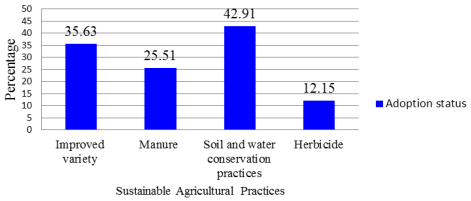
The survey result shows the soil and water conservation practice’s adoption rate was 42.91% followed by improved crop variety (35.63%), manure (25.51%) and herbicide (12.5%) respectively. The adoption of soil and water conservation practices is the highest among the four practices included in this study, which could indicate that farmers recognize the importance of the practices in the watershed. Improved variety adoption rate (35.63%) was low that needs encouraging farmers to use improved crop varieties. Manure is used as organic fertilizer helps to improve soil structure, water retention, and nutrient content. But, its adoption rate low as compared to other practices which was only 25.51%. In conclusion, further promotion of the use of soil and water conservation practices, improved variety, manure and herbicide can lead to sustainable agriculture production and productivity in the watershed (Figure 1).
Figure 1. Adoption Status of sustainable agricultural practices in Somodo watershed.
3.3. Determinants of Adoption of Sustainable Agricultural Practices in Somodo Watershed
Even though farmers employ several technologies in combination, there are a lot of factors that can affect their decision to select one over another. Multivariate Probit Model (MVP) was employed to identify the key factors that hinder the adoption of sustainable agricultural practices in the watershed. A statistically significant chi-square test result showed that the independent variables included in the model are relevant in explaining the differences in the adoption of the four interventions under consideration in the study (Wald chi2 (76) =324.53, p=0.000) Table 2. As explained by the likelihood ratio test’s, rejection of the independent assumption on the adoption of the four interventions, multivariate regression gives results that are more accurate than individual univariate. The model results were described and discussed as follows:
Demographic, Socio-economic and Institutional Factors
Even though farmers employ several technologies in combination, socio-economic and institutional factors can affect their decision to select one over another. Below are the key factors that affect the adoption of the multiple technologies in the watershed.
Age of the household head was determinant factor that explains the adoption of manure positively and significantly affected by age at 5% significance level. This is related with the assumption that older farmers were more likely to apply manure in their farmlands remembering its importance during their childhood when the use of in-organic fertilizer was very limited in crop production (Table 2). The result is consistent with the finding of that shows due to the experience accumulated over the farming years, especially with sustainable agricultural practices, the number of sustainable agricultural practices adopted increases with the age of household head. The model result further depicted that tropical livestock unit significantly and positively affected the choice of farmers to use manure and herbicide at 1% and 10% respectively. This also related to the assumption that the more the livestock owned the more manure is available and used in the farmer’s crop plots. Similarly, the larger the livestock owned the more resources to cultivate in agricultural production. Consequently, the more crops cultivated, increase the likelihood of using herbicide to control weed (Table 2). Cattle are the primary source for preparing the organic fertilizer indicating, higher average animal holdings among adopters may have accelerated manure adoption relative to farmers with lower livestock holdings .
Distance to the nearest main market affects adoption of manure positively and significantly at 5% significance level. The result of the model depicted that a one kilometer increase in distance to main market, increase the probability of adopting manure by 0.4%. The implication is that farmers located far from main markets often have limited access to commercial fertilizers and hence that they depend more likely on natural practices such as manure. On the other hand, manure is readily available in rural areas where the farmers less likely get access to main market. Soil and water conservation practice was also positively and significantly affected by distance to the nearest main market at 1%. This can be attributed to the assumption that farmers in remote areas rely on natural resources for their livelihoods as they less likely get access to market for other off-farm activities (Table 2). Distance to the nearest development agent office was negatively and significantly affected to the adoption of herbicide and SWC at a 5% each level of significance respectively. The implication is that the households located far from development agent office very less likely get any technical information on the usage of SWC practices and application of herbicide as compared to the farmers who approaches to development agent offices (Table 2). Technical advice given to the farmers positively and significantly affected the decision to adopt manure at 5% level of significance. Manure and compost preparation and usage need awareness creation to the farmers. Accordingly, the more they get any technical advice, the more they inspired to prepare and use manure in their crop production (Table 2). Similarly, red type of soil colour significantly and positively affected the adoption of manure negatively and significantly at 1% significance level. Conclusion of these findings needs further intervention and recommendation from soil research team.
Plot Characteristics
Plot distance affected adoption of herbicide and SWC practices positively and significantly at 1% and 5% significance level respectively; perhaps it affected manure significantly and negatively at 1%. The findings indicated that farmers frequently practice hand weeding for crop plot very nears to residential location as compared to plot found long distance from their surroundings and this could result in a more likelihoods for usage of herbicide for the distant crop plots. The positive relation between plot distance and adoption of SWC practices needs further study for conclusion. The implication for inverse relationship plot distance and adoption of manure is more likely related with the assumption that manure is mainly applied to crop produced on home garden. Hence, as the more crop plot is far from farmer’s residential location, the less they use manure (Table 2). Cultivated land was important variable in affecting farmer’s decision to adopt herbicide and manure at 5% each level of significance respectively. It affects the adoption of herbicide positively and manure negatively. This implies that more specifically, households owned small cultivated land were more likely to apply manure in their farmlands. Similarly, the more the cultivated land owned by the farmers, the more they use herbicide to control weed in their crop farm (Table 2).
Medium slope type of the slop significantly and positively affected adoption of herbicide and SWC in the watershed at 5% and 1% significance level. However, it affects manure adoption negatively at 5% level of significance. The implication is that farmers fear a risk and prefer medium slope than very sloppy plot for agricultural production and at the same time use different technologies including herbicide to protect weed and increase their production and productivity. Observationally, it evident that the topography of the watershed is also mainly medium slope and that encourages the households to practice the soil and water conservation on their farm. Medium slope negatively and significantly affected the adoption of manure at 5%. The implication is that manure is mainly used on garden for crop such as coffee, enset, chat and banana in Somodo watershed. Home garden farm land is more likely flat as compared to other crop land far away from residential house (Table 2). Medium fertility of the soil negatively and significantly affected the adoption of improved variety, manure and soil and water conservation practices at 5% each significance level. This could probably due to the assumption that the more the soil is fertile, the less the farmers use soil fertility improvement practices and improved crop varieties to reduce their cost of production (Table 2).
Table 2. Determinants of adoption of sustainable agricultural practices in Somodo watershed (Multivariate probit model result).

Explanatory Variables

Interventions

Variety

Herbicide

Manure

SWC

Socio-economic factors

Coeff. (Std. error)

Coeff. (Std. error)

Coeff. (Std. error)

Coeff. (Std.error)

Sex of the household

0.018 (0.259)

0.105 (0.381)

0.655* (0.343)

-0.024 (0.269)

Age of the respondents

-0.005 (0.006)

-0.002 (0.009)

0.018** (0.007)

0.003 (0.007)

Family size

0.001 (0.038)

0.040 (0.050)

-0.014 (0.044)

0.061 (0.040)

Education in years

-0.001 (0.024)

-0.013 (0.034)

0.038 (0.029)

0.02 7(0.026)

Tropical livestock unit

0.034 (0.048)

0.116* (0.060)

0.233*** (0.061)

0.094 (0.053)

Institutional factors

Distance to main market

-0.001 (0.002)

0.001 (0.002)

0.004** (0.002)

0.012*** (0.002)

Distance to extension agent

-0.006 (0.004)

-0.015** (0.007)

-0.008 (0.005)

-0.012** (0.005)

Technical advice

-0.038 (0.173)

-0.068 (0.227)

0.555** (0.225)

-0.093 (0.179)

Plot characteristics

Number of plot owned

0.058 (0.063)

-0.072 (0.091)

0.097 (0.077)

-0.105 (0.073)

Cultivated land (ha)

-0.166 (0.220)

0.777** (0.307)

-0.599** (0.262)

0.108 (0.248)

Sub-plot distance (km)

0.007 (0.009)

0.044*** (0.011)

-0.083*** (0.018)

0.024** (0.009)

Medium fertility

-0.408** (0.153)

0.354 (0.200)

-0.484** (0.181)

-0.375** (0.166)

Gentle slope

0.007 (0.698)

-0.490 (0.866)

3.326** (168.369)

0.155 (0.767)

Medium slope

0.133** (0.698)

-0.192 (0.865)

3.352** (168.369)

0.900 (0.769)

Medium depth

0.466** (0.205)

0.155 (0.290)

0.552** (0.233)

0.510** (0.218)

Brown colour (soil)

-0.034 (0.232)

0.846 (0.488)

-1.597*** (0.286)

0.714** (0.265)

Red colour (soil)

-0.264 (0.190)

0.775 (0.457)

-1.294*** (0.226)

0.326 (0.219)

_cons

-0.389 (0.924)

-1.595 (1.221)

-9.045 (203.541)

-2.329 (1.038)

Model diagnosis

Log likelihood

-797.43621

Number of obs

494

Wald chi 2(76)

324.53

Prob > chi 2

0.0000

Likelihood ratio test of rho 21 = rho 31 = rho 41 = rho 32 = rho 42 = rho 43 = 0: chi 2 (6) = 62.0423 Prob > chi 2 = 0.0000, the number in parenthesis is standard error and ***, **, * represents significance level at 1%, 5% and 10% respectively.
3.4. Impact of Sustainable Agricultural Practices Adoption on Income
In this study, endogenous switching regression model was employed to examine the impact of adopting sustainable agricultural practices in the watershed. For this particular objective (impact assessment), treatment group is defined as those who used any of the sustainable agricultural practices during the survey season and directly participated in the intervention; otherwise control group or non-user of the technologies. Table 3 presents the crop income and total income under actual and counterfactual conditions. Accordingly, households that adopted sustainable agricultural practices benefited more compared to their counterfactual. Those that used the sustainable agricultural practices would have crop income of 7,192.88 birr less had they not used; showing that households that did not use the sustainable agricultural practices would have obtained higher levels of crop income had they used. Similarly, using of sustainable agricultural practices increases the probability of annual income for households that did use the sustainable agricultural practices by 20,194.46 birr. Generally, the model result indicates adoption of sustainable agricultural practices statistically and significantly increases crop income and overall income of the farmers.
Table 3. Impact of sustainable agricultural practices on income.

Outcome Variables

Category

Decision Stage

Adoption effect

Users

Non- users

Crop cash income (Birr)

ATT

28,201.47

21,008.59

7,192.88***(2,553.756)

ATU

15,988.02

14,461.12

1,526.89 (5,261.736)

Total income (Birr)

ATT

60,466.74

40,272.28

20,194.46 ***(5,818.945)

ATU

31786.75

29027.64

2,759.109 (13415.01)

Standard errors in parenthesis; and ***denotes significance level 1%
4. Conclusion and Recommendations
4.1. Conclusion
Sustainable agricultural practices are essential for sustainably increasing crop and land productivity. Because of population pressure, highly variable and unreliable rainfall, steep topography, intensive cultivation, deforestation, overgrazing, and others, the Ethiopian highlands are much-degraded areas of the country, that need the implementation of sustainable agricultural practices by integrated soil and water management approach. Despite this, the county’s agriculture sector is known for using traditional techniques and approaches in using agricultural technologies. However, the success of agricultural sector in terms of increasing its contribution to the overall growth of the economy and ensuring food self-sufficiency depends on the use of different sustainable agricultural practices. Hence, research on the factors that determine the adoption of sustainable agricultural practices are crucial to enhancing agricultural and land productivity, conserving soil and water, and reducing poverty. Therefore, this study analyzed factors that influence the adoption of sustainable agricultural practices in Somodo watershed using data collected from a sample of 118 households. Multivariate probit (MVP) model was used since it was found that farmers were more motivated to use a variety of technologies rather than a single technology and has interdependent relationship. The four sustainable agricultural practices that were taken into consideration for this study were improved crop variety, herbicide, manure, and soil and water conservation practices. The result of the MVP model revealed that among the variables included in the analysis number of plot owned and tropical livestock unit were found to have a statistically significant effect on the decision to adopt herbicide whereas, technical advice, distance to the nearest extension, number of plot owned, tropical livestock unit, good soil fertility and red type of soil were found to significantly affect the choice to use manure. The model further indicated that technical advice significantly affected the decision to use improved crop varieties in the watershed. Besides, the decision to use soil and water conservation practices were influenced by sex, cultivated land, distance to main market, distance to development agent office, technical advice and medium slope of the farm plots significantly. On the other hand, endogenous switching model result indicates adoption of sustainable agricultural practices statistically and significantly increases crop income and total annual income of the farmers.
4.2 Recommendations
Based on the conclusion made, the following recommendations were drawn:
Even though, there are noticeable changes in the Somodo watershed, collaboration with the farmers and stakeholders is very crucial to ensure sustainability of the technologies in the watershed.
Organic fertilizers were mainly used for homestead crops such as coffee, banana, khat and enset. Based on, its importance and the current skyrocketing price of inorganic fertilizers, it is recommended to empower the farmers to use organic fertilizers such as manure and compost on their agricultural farms away from homestead.
The results of the econometric analysis indicate that technical advice is an important factor that affects the probability of investing in improved varieties, manure, and soil and water managements practices. Thus, matching sustainable agricultural practices with robust and regular provision of technical advice to farmers is of paramount importance for facilitating the decision-making about adoption of sustainable agricultural activities.
It is recommended that all stakeholders should pay due attention to empowering farmers to use different sustainable agricultural practices; improve soil health, increase crop productivity and income.
Abbreviations

ATT

Average Treatment Effect of the Treated

ATU

Average Treatment Effect on Untreated

CAPI

Computer-Assisted Personal Interview

ESRM

Endogenous Switching Regression Model

JARC

Jimma Agricultural Research Centre

MVP

Multivariate Probit Model

OLS

Ordinary Least Squares

SWC

Soil and Water Conservation

Conflicts of Interest
The authors declare no conflicts of interest.
References
[1] Geist HJ and Lambin EF, 2004. Dynamic causal patterns of desertification. Bioscience 54: 817–829.
[2] Mekonnen YK (edt.), 2013. Ethiopia: The Land, Its People, History and Culture. Intercontinental Books.
[3] Tesfaye A, Brouwer R, van der Zaag P, and Negatu W., 2016. Assessing the costs and benefits of improved land management practices in three watershed areas in Ethiopia. International Soil and Water Conservation Research, 4(1): 20-29.
[4] Taddese G, 2001. Land degradation: A challenge to Ethiopia. Environmental Management, 27: 815–824.
[5] Hurni H, 1984. Land degradation, famine, and land resource scenarios in Ethiopia In: D. Pimentel (Ed.), World soil erosion and conservation, 27–62. Cam-bridge: Cambridge University Press IWMI. Rome, Italy.
[6] Nicol A, Langan S, Victor M and Gonsalves J., 2015. Water-smart agriculture in East Africa. IWMI. Rome, Italy.
[7] Kalkidan F, Yalemtsehay D, Gizaw T., 2017. Assessment of Woody and Non-Woody Fuel Biomass Resource Availability and Rate of Consumption in the Somodo Model Watershed South-Western Ethiopia. Jimma Agricultural Research center, Jimma, Ethiopia. Journal of Environment and Earth Science 7(4).
[8] Tesfaye G, Debebe Y, Fikirie K., 2018. Soil Erosion Risk Assessment Using GIS Based USLE Model for Soil and Water Conservation Planning in Somodo Watershed, South West Ethiopia. Int J Environ Agric Res 4(5): 35-43.
[9] Dorfman, J., 1996. Modeling multiple adoption decisions in joint framework. American Journal of Agricultural Economics, 78, 547–557.
[10] Kassie, M., Jaleta, M., Shiferaw, B., Mmbando, F., Mekuria, M., 2013. Adoption of interrelated sustainable agricultural practices in smallholder systems: evidence from rural Tanzania. Technol. Forecasting Soc. 80, 525–540.
[11] Teklewold H., Kassie M., Shiferaw B. 2013. Adoption of Multiple Sustainable Agricultural Practices in Rural Ethiopia’, Journal of Agricultural Economics, 64 (3): 597–623.
[12] Marra, G., Radice, R., Filippou, P., 2017. Regression spline bivariate probit models: a practical approach to testing for exogeneity. Commun. Stat. Simul. Comput. 46, 2283–2298.
[13] Asfaw, S.; Kassie, M.; Simtowe, F.; Leslie, L., 2012. Poverty reduction effects of agricultural technology adoption: A micro-evidence from rural Tanzania. J. Dev. Stud. 2012, 48, 1288–1305.
[14] Oyetunde-Usman, Z., Olagunju, K. O. and Ogunpaimo, O. R., 2021. Determinants of adoption of multiple sustainable agricultural practices among smallholder farmers in Nigeria. International Soil and Water Conservation Research, 9(2), pp. 241-248.
[15] Milkessa D., 2020. Analysis of Determinants of Adoption and Use Intensity of Organic Fertilizer in Ejere District, West Shoa, Oromia, Ethiopia. A Thesis Submitted to Department of Economics in Partial Fulfillment of Requirements for Degree of Master Science in Economics (Economic Policy Analysis). Addis Ababa University.
[16] Belete, A. A., 2022. Determinants of organic fertilizer adoption in moretna jeru district, northern Ethiopia. Advances in Agriculture, 2022(1), p. 9983782.
Cite This Article
  • APA Style

    Asfaw, E., Erko, B. (2025). Adoption and Impact of Sustainable Agricultural Practices Among Smallholder Farmers in Somodo Watershed Jimma Zone, Southwest Ethiopia. Reports, 5(2), 24-32. https://doi.org/10.11648/j.reports.20250502.12

    Copy | Download

    ACS Style

    Asfaw, E.; Erko, B. Adoption and Impact of Sustainable Agricultural Practices Among Smallholder Farmers in Somodo Watershed Jimma Zone, Southwest Ethiopia. Reports. 2025, 5(2), 24-32. doi: 10.11648/j.reports.20250502.12

    Copy | Download

    AMA Style

    Asfaw E, Erko B. Adoption and Impact of Sustainable Agricultural Practices Among Smallholder Farmers in Somodo Watershed Jimma Zone, Southwest Ethiopia. Reports. 2025;5(2):24-32. doi: 10.11648/j.reports.20250502.12

    Copy | Download

  • @article{10.11648/j.reports.20250502.12,
      author = {Efrem Asfaw and Beza Erko},
      title = {Adoption and Impact of Sustainable Agricultural Practices Among Smallholder Farmers in Somodo Watershed Jimma Zone, Southwest Ethiopia
    },
      journal = {Reports},
      volume = {5},
      number = {2},
      pages = {24-32},
      doi = {10.11648/j.reports.20250502.12},
      url = {https://doi.org/10.11648/j.reports.20250502.12},
      eprint = {https://article.sciencepublishinggroup.com/pdf/10.11648.j.reports.20250502.12},
      abstract = {This study was aimed to identify the factors that influence smallholder farmers’ decisions to adopt four different sustainable agricultural practices (i.e. improved variety, manure, soil and water conservation practices and herbicide) and the impact on income of smallholder farmers in Somodo watershed, Jimma zone. Multistage sampling procedure that involves a combination of purposive and random sampling procedures was employed. Simple random sampling technique was used to select 118 smallholder farmers in the watershed where integrated watershed management interventions were implemented by Jimma Agricultural Research Center from 2011-2018. A questionnaire was administered to the 118 selected smallholder farmers and quantitative data type were collected and used in this study. Descriptive statistics, a multivariate probit and Endogenous switching regression model were used to analyze the data. The study result shows that 25.51% of farmers apply manure on their farm plots in the watershed. Improved variety, soil and water management practices and herbicide are adopted by 35.63%, 42.91% and 12.15% of farmers, respectively. The finding of the study revealed that adoption of sustainable agricultural practices were determined by sex, age, cultivated land size, technical advice, tropical livestock unit, distance to main market, distance to agricultural extension agent office, plot distance, medium soil fertility, medium slope of land and red color of soil. The study concluded that the adoption of different sustainable agricultural practices in combination had a positive impact on income of smallholder farmers and their adoption was influenced by socioeconomic, institutional, and soil characteristics. Therefore, it is recommended that all stakeholders should pay due attention to empowering farmers to use different sustainable agricultural practices; improve soil health, increase crop productivity and income. The positive effect of technical advice on sustainable agricultural practice’s adoption suggests the need for increased accessibility of practical training mainly on preparing manure and compost, soil and water conservation practices and use of improved crops varieties.
    },
     year = {2025}
    }
    

    Copy | Download

  • TY  - JOUR
    T1  - Adoption and Impact of Sustainable Agricultural Practices Among Smallholder Farmers in Somodo Watershed Jimma Zone, Southwest Ethiopia
    
    AU  - Efrem Asfaw
    AU  - Beza Erko
    Y1  - 2025/06/16
    PY  - 2025
    N1  - https://doi.org/10.11648/j.reports.20250502.12
    DO  - 10.11648/j.reports.20250502.12
    T2  - Reports
    JF  - Reports
    JO  - Reports
    SP  - 24
    EP  - 32
    PB  - Science Publishing Group
    SN  - 2994-7146
    UR  - https://doi.org/10.11648/j.reports.20250502.12
    AB  - This study was aimed to identify the factors that influence smallholder farmers’ decisions to adopt four different sustainable agricultural practices (i.e. improved variety, manure, soil and water conservation practices and herbicide) and the impact on income of smallholder farmers in Somodo watershed, Jimma zone. Multistage sampling procedure that involves a combination of purposive and random sampling procedures was employed. Simple random sampling technique was used to select 118 smallholder farmers in the watershed where integrated watershed management interventions were implemented by Jimma Agricultural Research Center from 2011-2018. A questionnaire was administered to the 118 selected smallholder farmers and quantitative data type were collected and used in this study. Descriptive statistics, a multivariate probit and Endogenous switching regression model were used to analyze the data. The study result shows that 25.51% of farmers apply manure on their farm plots in the watershed. Improved variety, soil and water management practices and herbicide are adopted by 35.63%, 42.91% and 12.15% of farmers, respectively. The finding of the study revealed that adoption of sustainable agricultural practices were determined by sex, age, cultivated land size, technical advice, tropical livestock unit, distance to main market, distance to agricultural extension agent office, plot distance, medium soil fertility, medium slope of land and red color of soil. The study concluded that the adoption of different sustainable agricultural practices in combination had a positive impact on income of smallholder farmers and their adoption was influenced by socioeconomic, institutional, and soil characteristics. Therefore, it is recommended that all stakeholders should pay due attention to empowering farmers to use different sustainable agricultural practices; improve soil health, increase crop productivity and income. The positive effect of technical advice on sustainable agricultural practice’s adoption suggests the need for increased accessibility of practical training mainly on preparing manure and compost, soil and water conservation practices and use of improved crops varieties.
    
    VL  - 5
    IS  - 2
    ER  - 

    Copy | Download

Author Information
  • Abstract
  • Keywords
  • Document Sections

    1. 1. Introduction
    2. 2. Methodology
    3. 3. Results and Discussion
    4. 4. Conclusion and Recommendations
    Show Full Outline
  • Abbreviations
  • Conflicts of Interest
  • References
  • Cite This Article
  • Author Information